When Phi Theta Kappa learned about everything that had happened in Haiti after the earthquake, our hearts were broken and we knew that it was our duty as PTK leaders to step up and do anything in our power to help those who suffered in Haiti.
We understood that the devastation in Haiti was massive, but we still wanted to do our part, as a united team, to lead a fundraiser in the effort around the world to aid Haiti.
We all did our part. Rene started to do some research about which international organization was better rated, with the guidance of PTK advisors who greatly supported this service project. We decided that Direct Relief organization was our best match for our fund. Next, our VP of publications, Jacqueline, made some wonderful flyers that were posted around campus and displayed in the screen savers of almost the entire library, learning center and administration building. Rene built 10 plastic donation boxes; some of them were not used because the Bookstore provide some fancy donation boxes which actually helped us collect more donations. The donations boxes that we used,were placed in specific areas by PTK students as this was a team effort.
We also sent a message calling on all PTK members and Officers, active and none-active, to support this cause which demanded the cooperation of all us. We also sent a message by our Canada College media or smccd email, to reach the entire general public of campus (all students and faculty). Our goal was to fundraise $500.
Furthermore, Nathalie one of our most new and active members lead another project to support the Haiti cause and also joined us in the fundraiser; this was a documentary. Finally, we left the donation boxes for the entire month of February. When the time came to collect the donations, we were short $50 to reach our goal. But Gabriela, one of our active members, persuaded the women soccer team at Canada, which she is part of, to help us reach our goal; Gabriella, the women’s soccer team and even their coach donated to help us reach our goal by donating a second time.
One of the greatest lessons we learned in this service project,(lead by the efforts of the entire chapter working as united team) was that we in Phi Theta Kappa: Beta Zeta Nu, set our own limits when it come to show leadership and compassion. Although this project took place at Canada, this was an international service project.
So we will send the money to Direct Relief which will use the money to purchase medical supplies and other needed items for Haiti.
Monday, March 1, 2010
Saturday, January 2, 2010
Healthy Food Drive
During our summer planning meetings our chapter discussed which of the eleven topics to focus on for the Paradox of Affluence. Jacqueline Santa-Iglesias and Isaiah Roggow decided to focus on health: If America is so rich, why are we as a nation so sick and unhealthy? Jacqui and Isaiah discovered and researched the Global Alliance for Chronic Disease (GACD), and read the book The China Study. Jacqueline and Isaiah met repeatedly to discuss ideas of how to present this problem to the student body as a teaching tool. After much consideration and debate, they decided to hold a Healthy Food Drive on campus and also organize a volunteer outing to Second Harvest, a local food bank. Second Harvest is dedicated to distributing food to the needy of the Bay Area and in health education programs in keeping with the ‘teach a man to fish’ mentality.
We wanted this to be an all-campus effort; Isaiah met with his fellow presidents of Associated Students of Canada College (ASCC) and TRIO and formed a Food Drive Committee from members of all three student organizations.
Bins were set out, the food drive was promoted, and guidelines were set as to what ‘healthy food’ meant. This was also a social experiment for us to see just how responsive people would be to such a restriction such as ‘please only donate healthy food.’ We also wanted to see just what people thought was healthy, as the definition is not clearly defined and is subjective.
We also received support from our local community in downtown Redwood City. Ruhina Karmali, who works at The Daily Boost, a local coffee shop heard of our efforts and offered to help. She set out our bins and gave people a free cup of coffee if they donated a food item to the cause.
After two months of collection, we had gathered five bins of food, in which we distributed it to eight Canada students who qualified for FAFSA. All that was left was a half-bin of food, which was donated to Second Harvest.
People kept pretty well inside the guidelines and brought in nutritious and wholesome food, proving anecdotally that on the whole people in our socioeconomic strata know what healthy food entails. This brought us back to the original question of if we as a nation know the right thing to do is eat healthy foods, why don’t we do it?
We want to give a big "Thank You!" to the entire Food Drive Committee-all the students that got on board and helped out printing/posting flyers, putting out collection bins, and collecting the donated food.
We wanted this to be an all-campus effort; Isaiah met with his fellow presidents of Associated Students of Canada College (ASCC) and TRIO and formed a Food Drive Committee from members of all three student organizations.
Bins were set out, the food drive was promoted, and guidelines were set as to what ‘healthy food’ meant. This was also a social experiment for us to see just how responsive people would be to such a restriction such as ‘please only donate healthy food.’ We also wanted to see just what people thought was healthy, as the definition is not clearly defined and is subjective.
We also received support from our local community in downtown Redwood City. Ruhina Karmali, who works at The Daily Boost, a local coffee shop heard of our efforts and offered to help. She set out our bins and gave people a free cup of coffee if they donated a food item to the cause.
After two months of collection, we had gathered five bins of food, in which we distributed it to eight Canada students who qualified for FAFSA. All that was left was a half-bin of food, which was donated to Second Harvest.
People kept pretty well inside the guidelines and brought in nutritious and wholesome food, proving anecdotally that on the whole people in our socioeconomic strata know what healthy food entails. This brought us back to the original question of if we as a nation know the right thing to do is eat healthy foods, why don’t we do it?
We want to give a big "Thank You!" to the entire Food Drive Committee-all the students that got on board and helped out printing/posting flyers, putting out collection bins, and collecting the donated food.

Monday, December 28, 2009
Second Harvest Food Bank
On December 5th and 19th, Beta Zeta Nu and Beta Xi Eta (College of San Mateo) teamed up to help out Second Harvest, a local food bank dedicated to feeding the hungry with nutritious and wholesome foods, in the spirit of Chapters United. Eighteen members from both chapters sorted food from 9am until noon to be distributed to families struggling with low-wage jobs, growing housing costs and homelessness with dozens of volunteers from local high schools and the community.
Our tasks included largely of sorting individually donated food-like from the Healthy Food Drive Beta Zeta Nu did over the holidays. That food was arranged into boxes for people who needed it to take home. The other job we did was making little 3 lb. bags of fresh produce. One group on December 5th sorted pallet boxes of carrots in this manner. The group on December 19th did the same thing for eight pallet boxes of oranges.
Second Harvest’s efforts help feed low-income seniors as well as low-income volunteers who are helping others while helping themselves. Volunteer support is essential for Second Harvest to maintain efficient and cost effective services. Because of Phi Theta Kappa’s efforts and that of other volunteers, over 205,000 people a month are able to receive food. The food is distributed through our partnering agencies, their satellites, and through Second Harvest Food Bank’s directs service programs.
Second Harvest deeply thanks Phi Theta Kappa for the time we took to help them achieve their vision, "Providing food for people in need in our community," which has made a difference for many this holiday season.
We have now formed a partnership with Second Harvest and plan on doing one food-sorting session with them once a month.

Our tasks included largely of sorting individually donated food-like from the Healthy Food Drive Beta Zeta Nu did over the holidays. That food was arranged into boxes for people who needed it to take home. The other job we did was making little 3 lb. bags of fresh produce. One group on December 5th sorted pallet boxes of carrots in this manner. The group on December 19th did the same thing for eight pallet boxes of oranges.
Second Harvest’s efforts help feed low-income seniors as well as low-income volunteers who are helping others while helping themselves. Volunteer support is essential for Second Harvest to maintain efficient and cost effective services. Because of Phi Theta Kappa’s efforts and that of other volunteers, over 205,000 people a month are able to receive food. The food is distributed through our partnering agencies, their satellites, and through Second Harvest Food Bank’s directs service programs.
Second Harvest deeply thanks Phi Theta Kappa for the time we took to help them achieve their vision, "Providing food for people in need in our community," which has made a difference for many this holiday season.
We have now formed a partnership with Second Harvest and plan on doing one food-sorting session with them once a month.

The Giving Tree Holiday Gift Drive Update
On December 18, 2009, Tristan and Rene picked up all 50 gifts as result of our holiday drive, which was a success! This was only possible because all of the efforts of the members and officers in the chapter as well as the staff, faculty and students who participated. People helped the drive in different ways, ranging from spreading the word to buying a gift. This holiday drive(The Giving Tree)was part of an even greater holiday drive led by The Family Giving Tree organization that does this every year. According to one representative about 60,000 gifts were collected over all. All these gifts were Christmas gifts for thousands of unprivileged children.
http://www.familygivingtree.org/
http://picasaweb.google.com/fgtpictures/2008HolidayWishDrive#5287905849904495634
http://www.familygivingtree.org/
http://picasaweb.google.com/fgtpictures/2008HolidayWishDrive#5287905849904495634
Spring 2010 Peer Counseling
Canada College has made serious budget cuts and consequently let a most all of our counselors go. (we only have three left) If we do not step up and help, our fellow students will be at an unnecessary disadvantage as they struggle through an unfamiliar registration system and plan for their future..
Foreseeing this problem, Isaiah Roggow (co-president) and Paul Roscelli (head advisor) spoke with the VP of Student Services, Peter Barbatis, early in the fall semester and again in the last week school. Peter is doing some very creative things to help new students get into the classes that they need with the least hassle as possible!
That's where Phi Theta Kappa comes in. We are helping by attending scheduled New Student Counseling & Registration Sessions. We guide new students in navigating our web-based registration program, Websmart, for the first time. There are usually 15-20 students per session and the peer counselors float around assisting as needed. There is one facilitator of the session, a counselor, that would be in charge.
The tasks include but not be limited to-helping with username/password issues, searching for classes, and registering for them. The greatest issue will be escalated demand and reduced supply of available and open classes. Most if not all classes in the convenient times are already full so much that students can't even waitlist for it. That translates to students being frustrated with having no options, having to take classes at CSM, or taking a class at an inconvenient time. Part of peer counselor’s job is to soothe people’s frustrations with so little available options.
We will have three peer counselors per session. The benefits for are many: helping your fellow future classmates, being a face for PTK and serve as its representative, and the privilege to say on university and scholarship applications that you participated in this event. The efforts put forth by our peer counselors may be the difference between someone getting a class or giving up on college.
Foreseeing this problem, Isaiah Roggow (co-president) and Paul Roscelli (head advisor) spoke with the VP of Student Services, Peter Barbatis, early in the fall semester and again in the last week school. Peter is doing some very creative things to help new students get into the classes that they need with the least hassle as possible!
That's where Phi Theta Kappa comes in. We are helping by attending scheduled New Student Counseling & Registration Sessions. We guide new students in navigating our web-based registration program, Websmart, for the first time. There are usually 15-20 students per session and the peer counselors float around assisting as needed. There is one facilitator of the session, a counselor, that would be in charge.
The tasks include but not be limited to-helping with username/password issues, searching for classes, and registering for them. The greatest issue will be escalated demand and reduced supply of available and open classes. Most if not all classes in the convenient times are already full so much that students can't even waitlist for it. That translates to students being frustrated with having no options, having to take classes at CSM, or taking a class at an inconvenient time. Part of peer counselor’s job is to soothe people’s frustrations with so little available options.
We will have three peer counselors per session. The benefits for are many: helping your fellow future classmates, being a face for PTK and serve as its representative, and the privilege to say on university and scholarship applications that you participated in this event. The efforts put forth by our peer counselors may be the difference between someone getting a class or giving up on college.
Wednesday, December 16, 2009
AOAE
Every year, Phi Theta Kappa and the Office of the President of Canada College engage in a joint effort to host an event that honors 200+ local high school students that earn a 3.5 GPA or higher at their respective schools. There are five such schools in and around our area, and many of their graduates seriously take Canada into consideration in regards to furthering their educational goals.
Isaiah was placed in charge and created a team to help him when needed. He was in constant contact with the College president’s office about getting the student’s names, their medals, the food, and other logistics.
The Afternoon of Academic Excellence is always held one week before our college’s graduation, which sets it to a Friday in late may. Approximately 80 high school students RSVP’d, but we ended up receiving and honoring 130 students instead. Fortunately, Isaiah and his team planned for this and no hiccups were experienced. Add to that friends and family, we ended up packing out the entire theatre.
This was a very challenging event to plan for. Isaiah had to get the names of all students from our five satellite high schools that scored a 3.5 GPA or higher and then get invitation letters to each of them. Each student had to RSVP to their career center and then I had Phi Theta Kappa members gather them at the high schools. It was the only way, as real RSVPs would have been extremely expensive and was outside our budget, which was already generously given by the college president’s office. Then there was the logistics of food, awards, and choosing a keynote speaker. We planned months in advance and due to our diligence, the Afternoon of Academic Excellence went off perfectly and with no problems. Our college President, Tom Mohr, was incredibly pleased with both my performance, my team, and of Phi Theta Kappa.
This event is incredibly important to the surrounding high schools. The Afternoon of Academic Excellence showcases to the high school students, their parents, and the administration of the schools the high quality that has been the norm at Canada College. Everyone likes to know from time to time that they are appreciated and valued. Many of these students have the potential to be first generation college attendees. This is most likely the first time they were to receive official recognition from a college for all their hard work over the course of high school. This event provides an opportunity to show these young people how much their efforts are appreciated. The students of Phi Theta Kappa believe that success begets success, and when these students come away from this event, they will have caught a glimpse of what they are working so hard and sacrificing so much for.
Afternoon of Academic Excellence is also a great opportunity to showcase the Canada College to prospective students that may not have a very positive image of what a community college is or of the students that attend one. This may be their first and only exposure to that. This event is one of the best student recruitment programs
There is still a cultural stigma surrounding community colleges. Whenever an event like this is held and is as successful as we, the students of a community college, made it, the image of community colleges gets a little more polish than it was when these teens entered. This is the singular event of the year does a fine job to ensure that community colleges, our nation’s ‘best kept secret,’ are a little less well-kept.
Isaiah was placed in charge and created a team to help him when needed. He was in constant contact with the College president’s office about getting the student’s names, their medals, the food, and other logistics.
The Afternoon of Academic Excellence is always held one week before our college’s graduation, which sets it to a Friday in late may. Approximately 80 high school students RSVP’d, but we ended up receiving and honoring 130 students instead. Fortunately, Isaiah and his team planned for this and no hiccups were experienced. Add to that friends and family, we ended up packing out the entire theatre.
This was a very challenging event to plan for. Isaiah had to get the names of all students from our five satellite high schools that scored a 3.5 GPA or higher and then get invitation letters to each of them. Each student had to RSVP to their career center and then I had Phi Theta Kappa members gather them at the high schools. It was the only way, as real RSVPs would have been extremely expensive and was outside our budget, which was already generously given by the college president’s office. Then there was the logistics of food, awards, and choosing a keynote speaker. We planned months in advance and due to our diligence, the Afternoon of Academic Excellence went off perfectly and with no problems. Our college President, Tom Mohr, was incredibly pleased with both my performance, my team, and of Phi Theta Kappa.
This event is incredibly important to the surrounding high schools. The Afternoon of Academic Excellence showcases to the high school students, their parents, and the administration of the schools the high quality that has been the norm at Canada College. Everyone likes to know from time to time that they are appreciated and valued. Many of these students have the potential to be first generation college attendees. This is most likely the first time they were to receive official recognition from a college for all their hard work over the course of high school. This event provides an opportunity to show these young people how much their efforts are appreciated. The students of Phi Theta Kappa believe that success begets success, and when these students come away from this event, they will have caught a glimpse of what they are working so hard and sacrificing so much for.
Afternoon of Academic Excellence is also a great opportunity to showcase the Canada College to prospective students that may not have a very positive image of what a community college is or of the students that attend one. This may be their first and only exposure to that. This event is one of the best student recruitment programs
There is still a cultural stigma surrounding community colleges. Whenever an event like this is held and is as successful as we, the students of a community college, made it, the image of community colleges gets a little more polish than it was when these teens entered. This is the singular event of the year does a fine job to ensure that community colleges, our nation’s ‘best kept secret,’ are a little less well-kept.
Monday, December 14, 2009
Healthy Food Drive
In conjunction with the Healthy Food Drive, on Dec 5th a group of 8 members from Beta Zeta Nu and Beta Xi Eta sorted food to be distributed to families struggling with low-wage jobs, growing housing costs and homelessness. Their efforts helped feed low-income seniors, as well as low-income volunteers who are helping others while helping themselves. Volunteer support is essential for Second Harvest to maintain efficient and cost effective services. Because of them and other volunteers, over 205,000 people a month are able to receive food. .
Second Harvest is deeply we appreciative of the time PTK took to help them achieve their vision: "Providing food for people in need in our community." PTK's gift of time has made a difference for many in our community.
Year round, the Food Bank is always in need of volunteer help and we plan you will be able to join them again. We look forward to that continued partnership.
Second Harvest is deeply we appreciative of the time PTK took to help them achieve their vision: "Providing food for people in need in our community." PTK's gift of time has made a difference for many in our community.
Year round, the Food Bank is always in need of volunteer help and we plan you will be able to join them again. We look forward to that continued partnership.
Monday, November 30, 2009
Holiday Wishing Tree 2009
Last year, one of our members presented our chapter with the opportunity to give bay area foster children a happier Christmas season--through a "Wishing Tree". This toy donation drive works by connecting foster children's holiday wish lists with generous toy donors in the area through a "Wishing Tree" which is decorated with the children's individual Christmas cards, each with a child's name and wanted present. While we were honored to help foster children in need, this toy drive was a challenge as the request to help the drive came only a few weeks before the close of the school year and the Christmas holiday. Despite this challenge, BZN members, Canada students and staff were able to respond to every single card and gift request on the tree, and the presents were delivered in time to the local foster children.
In an effort to make a difference in the lives of young children this holiday season, PTK members again joined forces in order make this toy drive happen. We set up a Christmas tree at the entrance of the campus Learning Center and decorated it with wish-cards from poor children who may not get a gift this holiday season unless someone with a good heart picks one of those wish-cards.We are proud to sponsor this holiday drive and look forward to its success.
In an effort to make a difference in the lives of young children this holiday season, PTK members again joined forces in order make this toy drive happen. We set up a Christmas tree at the entrance of the campus Learning Center and decorated it with wish-cards from poor children who may not get a gift this holiday season unless someone with a good heart picks one of those wish-cards.We are proud to sponsor this holiday drive and look forward to its success.
City Trees 2009
In 2007 Phi Theta Kappa and CityTrees, an urban forestry group, united in a joint effort with a simple mission: plant as many trees as possible in the Redwood City area. CityTrees has the full support of the Redwood City council and we plant trees on city land wherever there is space, most often in those patches of ground between the street and the sidewalk. We plant, prune, and maintain trees during the spring, summer, and fall. It is a very rewarding experience. There are always at least two of us present, and the plantings and prunings attract other students from Canada as well. Since we have started working with CityTrees, we have helped plant four hundred and twenty trees over the course of these past two years.
Following another planting experience with City Trees, Beta Zeta Nu Fall 2009 President Isaiah Roggow explained "My experience with CityTrees has raised my awareness and created in me a connection to the earth that I never before held. All my life I have heard it said that it is good to go ‘plant a tree,’ but to actually do that is a rewarding experience. Then to watch it grow and return to it a few years later to pull out the support stakes and prune the errant branches is a wonderful event for me. It really helped to raise my awareness of nature and of the verdant power of life. We as species are so destructive and prone to the taking of life. It helps me to know I am helping in a larger effort to give back to nature, to create and give life back and keep America beautiful, one tree at a time."
Here are a few pictures from our recent tree planting and pruning experience with City Trees.


Following another planting experience with City Trees, Beta Zeta Nu Fall 2009 President Isaiah Roggow explained "My experience with CityTrees has raised my awareness and created in me a connection to the earth that I never before held. All my life I have heard it said that it is good to go ‘plant a tree,’ but to actually do that is a rewarding experience. Then to watch it grow and return to it a few years later to pull out the support stakes and prune the errant branches is a wonderful event for me. It really helped to raise my awareness of nature and of the verdant power of life. We as species are so destructive and prone to the taking of life. It helps me to know I am helping in a larger effort to give back to nature, to create and give life back and keep America beautiful, one tree at a time."
Here are a few pictures from our recent tree planting and pruning experience with City Trees.


Monday, November 23, 2009
PTK and the Canada College Honors Program - 2009
The Chapter continued their leadership and scholarship role in their contribution to, and expansion of, the educational opportunities for Canada Students. Capitalizing on research that showed an interest in an honors program, several PTK officers and members served the entire year on the honors program steering committee. The students were given the responsibility to help create, implement and review the success of: the mission of the program; criteria for entrance into the program; student learning outcomes for the program; criteria for graduation with honors; a reflection tool upon exit of the class; course offerings. The students also recognized an opportunity to market the new program beyond our college when our sister institution, The College Of San Mateo, due to budget cuts eliminated their honors program.
In addition, the students used the Phi Theta Kappa Leadership Series reader and with their professor constructed a new honors leadership course in Spring of 2010 for all college students. The students, after researching and discussing the many aspects of leadership helped to create syllabus from the interdisciplinary readings in the Phi Theta Kappa reader. Finally, the class will be taught, in part, by campus leaders and is being called: Real Leadership: Real Leaders. The first of its kind ever offered at the college.
In addition, the students used the Phi Theta Kappa Leadership Series reader and with their professor constructed a new honors leadership course in Spring of 2010 for all college students. The students, after researching and discussing the many aspects of leadership helped to create syllabus from the interdisciplinary readings in the Phi Theta Kappa reader. Finally, the class will be taught, in part, by campus leaders and is being called: Real Leadership: Real Leaders. The first of its kind ever offered at the college.
Tuesday, November 10, 2009
Rise & Fall of The Maya Lecture
On Wednesday, October 21st, Professor of Race & Ethnicities History, Charles “Chuck” Carlson in collaboration with Yolanda’ Valenzeula’s La Raza class co-sponsored an lecture on the rise and fall of the Mayan Civilization that Beta Zeta Nu chapter produced. Vice President of Fellowship, Ryan Calic brainstormed with Chuck Carlson, who agreed to be the main speaker for the event. Then Chuck Carlson came to one of our chapter meetings with his and Ryan’s proposal, which the chapter enthusiastically endorsed. A lot of leg work went into putting together the event. Ryan took the high demographic of Hispanic students into his considerations for choosing the topic of discussion; 1) Many Latinos have some collective, shared sense of Mayan ancestry and take pride in that aspect of their heritage, 2) Ryan and Professor Carlson wanted to show the rise and fall of a civilization on a trajectory based on the honors topic that would tie in with parallels of why modern nation states rise and fall based in a paradox of affluence and leadership decisions i.e., what worked and didn’t work in terms of leadership in governance of these civilizations ad naseam, 3) The consensus between Ryan, Carlson, and the chapter was that trajectories measuring the rise and fall of European and Asian civilizations had been “discussed to death,” so, in solidarity it was decided that a event should examine the rise and fall of a civilization that hadn’t been lectured on as much at community colleges.
Of course, we couldn’t have pulled it all off without the indispensable contributions of chapter alumni, Carl Noe, who tracked down and purchased containers of authentic Mayan style hot chocolate, produced flyers, which Ryan received stamps of approval for posting by Aja Butler, the Director of Student Activities Office on campus, and Carl also brought in an ethnic Mayan named Gerardo, a Canada alumni, who read a poem he wrote for the event. After a bit of confusion about when and where to pick up the hot chocolate, Ryan and Jonathan were able to secure a coffee vat to brew the cocoa prior to the event. Ryan and Jonathan then prepared the cocoa, stirred and mixed it. There was supposed to be a showing of a film about the Maya, “Popolvu,” between 12:00 P.M. – 1:00 P.M., but nobody came to watch it. The presentation began at 1:00 P.M. Ryan, Jonathan, Blanca, Carl, advisors, Lisa Palmer, & Paul Roscelli were in attendance. We had the event in Building 13-210. We had room for about 55 people and nearly every seat was fill by students that had come to see the program out of interest and or extra credit points from their professors. Ryan first introduced Dean of Humanities, Jenny Castillo, who in turn introduced Yolanda Valenzuela, and then introduced Gerardo. Then Ryan presented Chuck Carlson.
Chuck began with a powerpoint presentation. He showed some slides that showed what areas of Mexico and Central America that the Mayans inhabited, their governmental , leadership, and socio-economic infrastructure. He then tried to emphasize that the Mayans hadn’t completely faded away as a civilization and how the C.I.A. and Cold War paranoia had stifled the subsistence and socio-economic growth of the descendants of the Mayan. Some students seemed a little lost when Chuck referenced the C.I.A. and the Cold War, but the lecture went on smoothly. Chuck tied up the powerpoint with a slide giving reasons and questions for why civilizations rise and fall as well as what lessons we could learn from the Maya in terms of not repeating their mistakes in terms of a paradox of affluence and what leadership decisions should and shouldn’t be implemented of theirs. There was supposed to be a Q & A at the end, but it ended up happening within the lecture, which showed there was great enthusiasm and interest on behalf of those in attendance. The event finished on time at 2:00 P.M. Everyone said they enjoyed the presentation and generously helped themselves to the refreshments at the conclusion. Overall this leadership event met all the four hallmarks of Phi Theta Kappa, which should give everyone as reason to feel good as gold!
Of course, we couldn’t have pulled it all off without the indispensable contributions of chapter alumni, Carl Noe, who tracked down and purchased containers of authentic Mayan style hot chocolate, produced flyers, which Ryan received stamps of approval for posting by Aja Butler, the Director of Student Activities Office on campus, and Carl also brought in an ethnic Mayan named Gerardo, a Canada alumni, who read a poem he wrote for the event. After a bit of confusion about when and where to pick up the hot chocolate, Ryan and Jonathan were able to secure a coffee vat to brew the cocoa prior to the event. Ryan and Jonathan then prepared the cocoa, stirred and mixed it. There was supposed to be a showing of a film about the Maya, “Popolvu,” between 12:00 P.M. – 1:00 P.M., but nobody came to watch it. The presentation began at 1:00 P.M. Ryan, Jonathan, Blanca, Carl, advisors, Lisa Palmer, & Paul Roscelli were in attendance. We had the event in Building 13-210. We had room for about 55 people and nearly every seat was fill by students that had come to see the program out of interest and or extra credit points from their professors. Ryan first introduced Dean of Humanities, Jenny Castillo, who in turn introduced Yolanda Valenzuela, and then introduced Gerardo. Then Ryan presented Chuck Carlson.
Chuck began with a powerpoint presentation. He showed some slides that showed what areas of Mexico and Central America that the Mayans inhabited, their governmental , leadership, and socio-economic infrastructure. He then tried to emphasize that the Mayans hadn’t completely faded away as a civilization and how the C.I.A. and Cold War paranoia had stifled the subsistence and socio-economic growth of the descendants of the Mayan. Some students seemed a little lost when Chuck referenced the C.I.A. and the Cold War, but the lecture went on smoothly. Chuck tied up the powerpoint with a slide giving reasons and questions for why civilizations rise and fall as well as what lessons we could learn from the Maya in terms of not repeating their mistakes in terms of a paradox of affluence and what leadership decisions should and shouldn’t be implemented of theirs. There was supposed to be a Q & A at the end, but it ended up happening within the lecture, which showed there was great enthusiasm and interest on behalf of those in attendance. The event finished on time at 2:00 P.M. Everyone said they enjoyed the presentation and generously helped themselves to the refreshments at the conclusion. Overall this leadership event met all the four hallmarks of Phi Theta Kappa, which should give everyone as reason to feel good as gold!
Monday, November 9, 2009
Arts and Olive Fest 2009
Our chapter recently participated in the Arts & Olive Festival by hosting the Phi Theta Kappa booth, which was open at the Arts & Olive Festival on Sunday Oct 4 from 10am-5pm.
Phi Theta Kappa has always been an organization that encourages new members to join. This was the exact goal of the members (Carl Noe, Rene Rivera, and Tristan Sheldon) participating at the Art and Olive Festival. During the festival we: informed people about the different programs that Phi Theta Kappa is participating in such as Project Read, engaged people in conversation about the benefits of joining Phi Theta Kappa and informed them of the orientation times and locations, and increased Phi Theta Kappa’s budget by selling bottles of water.
To organize this event, we gathered the appropriate resources: participants from Phi Theta Kappa, the booth, Phi Theta Kappa materials, bottles of water, and a bag of ice. We promoted this event by advertising via email, fliers, and our website which we updated to show our presence at this event. The booth was acquired from the school which held the event; we were assigned a location on the school grounds and a booth. The Phi Theta Kappa materials such as fliers and the banner were acquired at school as well from storage closet. The bottles of water were a last minute fund raising decision and we got the water from the storage room and Tristan picked up the ice for the water at a local grocery store.
This event was successful because the Phi Theta Kappa members helped promote Phi Theta Kappa to potential new members. We communicated with potential members about our chapter of PTK, talked with community members, students and parents about the role of PTK in the community and on campus.
Phi Theta Kappa has always been an organization that encourages new members to join. This was the exact goal of the members (Carl Noe, Rene Rivera, and Tristan Sheldon) participating at the Art and Olive Festival. During the festival we: informed people about the different programs that Phi Theta Kappa is participating in such as Project Read, engaged people in conversation about the benefits of joining Phi Theta Kappa and informed them of the orientation times and locations, and increased Phi Theta Kappa’s budget by selling bottles of water.
To organize this event, we gathered the appropriate resources: participants from Phi Theta Kappa, the booth, Phi Theta Kappa materials, bottles of water, and a bag of ice. We promoted this event by advertising via email, fliers, and our website which we updated to show our presence at this event. The booth was acquired from the school which held the event; we were assigned a location on the school grounds and a booth. The Phi Theta Kappa materials such as fliers and the banner were acquired at school as well from storage closet. The bottles of water were a last minute fund raising decision and we got the water from the storage room and Tristan picked up the ice for the water at a local grocery store.
This event was successful because the Phi Theta Kappa members helped promote Phi Theta Kappa to potential new members. We communicated with potential members about our chapter of PTK, talked with community members, students and parents about the role of PTK in the community and on campus.
Monday, November 2, 2009
Be the Change Day
On October 3rd, Beta Zeta Nu joined other volunteer workers for Be The Change Day.
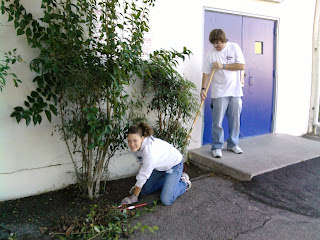
In this project, students from our chapter (Jonathan Werden, Rene Rivera, Jeremy Morales, Estrella Morales , Ryan calic, David Carrillo, Francisco Lopez, and Rachel Rankin) went into a local school (Edison-Brentwood Elementary) to beautify and repair it. After splitting up into different task teams, we began doing various jobs that we were assigned to. These included the following; repairing benches, weeding the school grounds, planting new flowers and trees, and repainting the benches, various murals, playgrounds, and roof support poles.
BZN members participated in a community service project, learned about the material needs of less affluent school children, and beautified a local East Palo Alto school.
In this project, students from our chapter (Jonathan Werden, Rene Rivera, Jeremy Morales, Estrella Morales , Ryan calic, David Carrillo, Francisco Lopez, and Rachel Rankin) went into a local school (Edison-Brentwood Elementary) to beautify and repair it. After splitting up into different task teams, we began doing various jobs that we were assigned to. These included the following; repairing benches, weeding the school grounds, planting new flowers and trees, and repainting the benches, various murals, playgrounds, and roof support poles.
BZN members participated in a community service project, learned about the material needs of less affluent school children, and beautified a local East Palo Alto school.

Secret Waterfall Beach Clean-up 2009
On October 25th, thirty total students participated in Secret Waterfall Beach Clean-up 2009. Canada College’s local chapter, Beta Zeta Nu, teamed up with three other chapters to lend our full weight to clean up a beach in Pacifica infamous for its pollution by the local populace. We joined forces with The College of San Mateo’s chapter, Beta Xi Eta, and the De Anza chapter, Alpha Sigma Alpha. The location we visited was ‘The Secret Waterfall,’ which has become a trash depository of the suburbia of northern Pacifica.
This entire effort was directed by a non-profit organization called the Pacifica Beach Coalition, lead by their president, Lynn Edwards.
When we arrived, the beach looked horrible. There is a waterfall deep in the cliffs that forms a stream to the beach. Trash was everywhere up and along the stream leading to the ocean, where the waves would then grab the detritus and take it out to sea. The usual suspects were present: bottles, bags, cigarette butts, lighters, and other flotsam. However, by far the most threatening, ubiquitous, and pernicious item was the thousands of pebble-sized pieces of Styrofoam scattered over the one hundred square feet of the environs of the stream. Birds, fish, and other marine life eat these bite-sized pellets ignorant of the death sentence they levy. The consequence is for every piece of styrofoam the size of a head of a pin a fish eats, a fish dies. Multiply that by hundreds of thousands, and it becomes clear why our world is in a fish population crisis.
To find out just how many pellets of styrofoam were strewn about the area, I measured out a 10'x10' square of ground. I had people gather every piece of styrofoam. We then measured the creek area and then extrapolated how many styrofoam bits there were on the entire site. It was calculated that there was approximately 1,500,000 bits of styrofoam in the Secret Waterfall site alone. There are hundreds of these kinds of streams feeding into our oceans and our food supply. That results in millions of pieces of styrofoam going into the sea and killing its equivalent in sea life. It really opened my eyes and significantly raised my awareness on how we are unwittingly killing thousands of members of the food chain that we as a race depend on for survival.
Our group picked up approximately 100 lbs of plastic at the site, which means we saved a lot of birds and sea life from choking and prevented more waste from polluting the environment. The president of the Pacifica beach coalition took the bags to the next city council meeting and presented them to them to give them a stark visual of how new ordinances need to be put in place if we are to have an impact in saving vital members of the food chain upon which we depend.


This entire effort was directed by a non-profit organization called the Pacifica Beach Coalition, lead by their president, Lynn Edwards.
When we arrived, the beach looked horrible. There is a waterfall deep in the cliffs that forms a stream to the beach. Trash was everywhere up and along the stream leading to the ocean, where the waves would then grab the detritus and take it out to sea. The usual suspects were present: bottles, bags, cigarette butts, lighters, and other flotsam. However, by far the most threatening, ubiquitous, and pernicious item was the thousands of pebble-sized pieces of Styrofoam scattered over the one hundred square feet of the environs of the stream. Birds, fish, and other marine life eat these bite-sized pellets ignorant of the death sentence they levy. The consequence is for every piece of styrofoam the size of a head of a pin a fish eats, a fish dies. Multiply that by hundreds of thousands, and it becomes clear why our world is in a fish population crisis.
To find out just how many pellets of styrofoam were strewn about the area, I measured out a 10'x10' square of ground. I had people gather every piece of styrofoam. We then measured the creek area and then extrapolated how many styrofoam bits there were on the entire site. It was calculated that there was approximately 1,500,000 bits of styrofoam in the Secret Waterfall site alone. There are hundreds of these kinds of streams feeding into our oceans and our food supply. That results in millions of pieces of styrofoam going into the sea and killing its equivalent in sea life. It really opened my eyes and significantly raised my awareness on how we are unwittingly killing thousands of members of the food chain that we as a race depend on for survival.
Our group picked up approximately 100 lbs of plastic at the site, which means we saved a lot of birds and sea life from choking and prevented more waste from polluting the environment. The president of the Pacifica beach coalition took the bags to the next city council meeting and presented them to them to give them a stark visual of how new ordinances need to be put in place if we are to have an impact in saving vital members of the food chain upon which we depend.


PTK returns to the Redwood City Symphony
Beta Zeta Nu returned to support the Redwood City Symphony at Canada College this October. Members, including Rachel, Jessica, Gavi, Jhatan, Sarah and Jacqueline, helped set up for the performance, attended to concessions before the concert, during intermission and after the concert and helped with clean up in the facility. We also filled in for absent ushers during the performance.
Here, members gained valuable service experience in volunteer work for a community performance, event organization and planning as well as the cultural experience of live, professional classical music. This performance helps bring prestige and positive exposure to Canada College, and Beta Zeta Nu provides the symphony with an appropriate venue as well as the necessary manpower to allow them to continue their performances in Redwood City.
Here, members gained valuable service experience in volunteer work for a community performance, event organization and planning as well as the cultural experience of live, professional classical music. This performance helps bring prestige and positive exposure to Canada College, and Beta Zeta Nu provides the symphony with an appropriate venue as well as the necessary manpower to allow them to continue their performances in Redwood City.
Kiva updates
This fall we're are continuing our support of entrepreneurs in developing countries with our ongoing participation in the organization Kiva. Kiva is the first of its kind, an international micro-lending organization which connects impoverished nations and their burgeoning small business communities with individuals online who want to help these businesses grow through micro-loans.
Here's a little about the new group of entrepreneurs we're helping in Tanzania:
Garlos Robson is young business owner in Tanzania, who owns a "duka" ("shop" in Kiswahili) where he sells items like oil, sodas, and water and has had this business since 2004. He will use the loan to buy more inventory for his store and recycle his profits into the business to help it grow. Garlos is part of a business group called Kisiwani, which has sixteen members.The sixteen group members run a variety of small businesses, from clothes shops, to vegetable and fruit "table top" stands, to carpentry businesses.
To learn more about Garlos and the Kisiwani group, click below.
http://www.kiva.org/app.php?page=businesses&action=about&id=146782&_te=ty
Here's a little about the new group of entrepreneurs we're helping in Tanzania:
Garlos Robson is young business owner in Tanzania, who owns a "duka" ("shop" in Kiswahili) where he sells items like oil, sodas, and water and has had this business since 2004. He will use the loan to buy more inventory for his store and recycle his profits into the business to help it grow. Garlos is part of a business group called Kisiwani, which has sixteen members.The sixteen group members run a variety of small businesses, from clothes shops, to vegetable and fruit "table top" stands, to carpentry businesses.
To learn more about Garlos and the Kisiwani group, click below.
http://www.kiva.org/app.php?page=businesses&action=about&id=146782&_te=ty
Wednesday, October 28, 2009
Make a Difference Day
On Saturday, October 24th Ryan Calic attended a Make A Difference Day event organized by the De Anza chapter through an organization called Save The Bay. He arrived at the wetlands by the Dumbarton Bridge in Menlo Park around 9 am. He was met there by De Anza’s chapter officers, Therese Thian, Ka Lee and several others from their chapter. First they got together and listened to a Save The Bay representative who talked about a short history of the wetlands, of which 90% of had been destroyed by urban sprawl and salt pond production. Then they gave a demonstration of which invasive plants to weed out as well as instructions were picking up trash. Then everyone got to work after being provided with trash bags, gloves, and trowels. It took about an hour to pull most of the weeds; the rest of the morning was spent on trash pickup. Most of the trash consisted of paper and plastic waste, such a bottles, scraps of paper, wrappers, and Styrofoam. We finished at noon. Ryan along with the De Anza officers answers some trivia questions based on what we learned at the site. The morning was quite productive in terms of meeting our Service and Fellowship Hallmarks and helped motivate De Anza’s officers to participate in our beach cleanup in Pacifica the next day host by our chapter. This event also contributes to the Chapters United mission of Phi Theta Kappa.
Monday, September 14, 2009
Redwood City Symphony
"The Symphony's great strength is its intrepid explorations in repertoire, which are often quite courageous for a community group." --San Francisco Classical Voice
We had the great pleasure in once again hosting the Redwood Symphony Orchestra at Cañada College. The PTK volunteers (Jenna Murphy, Said Taibi, Violeta Crow, Aldo Garcia, Isaiah Roggow, and Johnathan Werden) set up, ran, and broke down the concession and ticket stand. In between those duties, when the Orchestra was performing, the volunteers could sit and withness one of the best volunteer symphonies in the country.
By volunteering to perform the logistics of a concert for an all volunteer orchestra, Beta Zeta Nu was able to help bring art to the local population of students and community members. We were also able to build relationships between Beta Zeta Nu members and the event coordinators.
We had the great pleasure in once again hosting the Redwood Symphony Orchestra at Cañada College. The PTK volunteers (Jenna Murphy, Said Taibi, Violeta Crow, Aldo Garcia, Isaiah Roggow, and Johnathan Werden) set up, ran, and broke down the concession and ticket stand. In between those duties, when the Orchestra was performing, the volunteers could sit and withness one of the best volunteer symphonies in the country.
By volunteering to perform the logistics of a concert for an all volunteer orchestra, Beta Zeta Nu was able to help bring art to the local population of students and community members. We were also able to build relationships between Beta Zeta Nu members and the event coordinators.
High School Outreach
As part of our effort to connect with local high schools, Rene Rivera represented Phi Theta Kappa during a summer Cañada campus tour for high school students. The purpose of this presentation was to reach out to future students of Cañada and possible future PTK members. It was important to show the incoming students the programs and clubs available to them, including PTK, and show why it was important for them to stay active in their campus and community. The presentation was provided in Spanish to support these first generation immigrant students who spoke very little English. Thanks to Rene, these students have a better knowledge of the possibilities for greater enrichment as college students.
Library Foundation
On August 23rd, Beta Zeta Nu helped the Library Foundation of Redwood City raise money at the North Fair Oaks Festival in Redwood City. The money was intended to help the Library Foundation purchase materials for Redwood City libraries, which would benefit the community at large. We gathered volunteers from the chapter (Aldo Garcia, Violeta Crow and Rene Rivera) and sold raffle tickets to passers-by at our booth in the festival. The foundation was raffling attractive prizes, such as an iPod, soccer ball, tickets for a Giants game and more. The event was fun for the chapter as well as the community and we were able to raise about $400 for a noble cause. We were also able to represent students of Cañada College and Phi Theta Kappa.
Subscribe to:
Posts (Atom)
